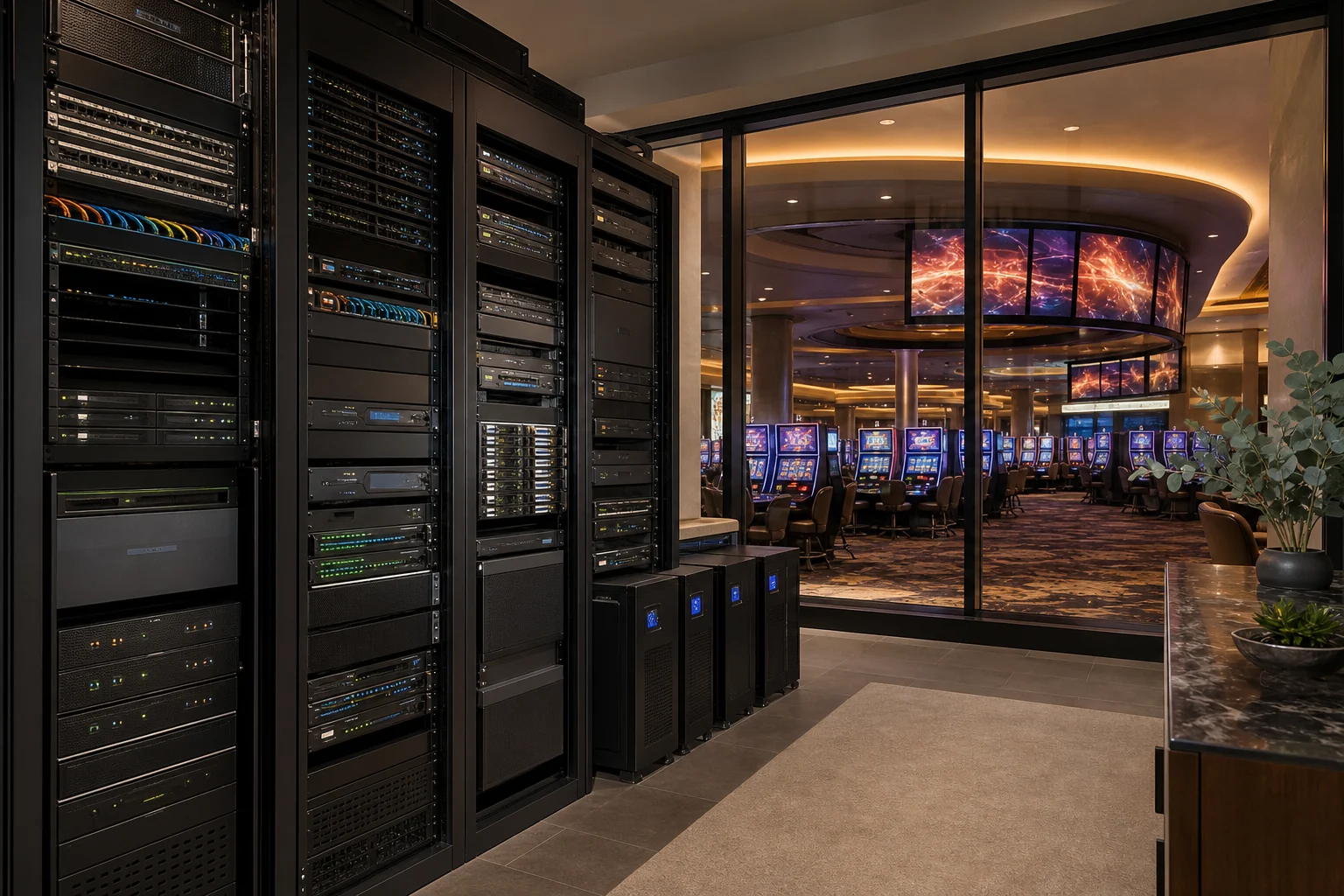
Draw the architecture before selecting devices.
Prepare a system context diagram showing casino management platforms, approved electronic gaming equipment, table systems, kiosks, displays, audio, clocks, surveillance interfaces where authorised, identity services, reporting, vendor support paths and external dependencies. Define which organisation owns each system and data set.
Keep regulated gaming functions distinct from corporate, guest, building, AV and surveillance environments. Interfaces should be explicitly approved, documented and minimised. This page provides high-level design guidance, not instructions for accessing or configuring regulated systems.
| Technology layer | Purpose | Design evidence |
|---|---|---|
| Casino management system | Approved operational, accounting, device, table or patron functions as permitted | Approved architecture, interfaces, roles, audit, resilience, support and data governance |
| Floor network | Secure connectivity for approved equipment and services | Segmentation, capacity, redundancy, port schedule, monitoring and change control |
| AV and digital signage | Wayfinding, information, event and ambient content | Source-to-screen diagram, resolution, transport, control, fallback and content ownership |
| Technical rooms and racks | Controlled housing for network, server, AV and power equipment | Rack elevations, loads, cooling, access, labelling, fire strategy and growth allowance |
| Power continuity | Safe shutdown or continued service for defined critical systems | Critical-load schedule, UPS/generator coordination, runtime, bypass, monitoring and test plan |
| Time and logging | Consistent event timing across authorised platforms | Approved time source, system hierarchy, monitoring, retention and clock display strategy |
Design networks around trust boundaries.
Develop logical and physical architecture with the operator, regulator, vendors and cybersecurity advisers. Define zones, allowed communications, authentication, administrative access, monitoring and ownership. Avoid unmanaged connections between supplier devices and other venue networks.
Size switching, uplinks, address space, fibre, wireless services where authorised and rack capacity for the commissioned load plus agreed growth. Use a port and cable schedule tied to asset IDs and floor locations. Redundant paths are useful only when they do not share one unrecognised failure point.
Remote support is an interface, not an exception. It should be explicitly authorised, strongly authenticated, time-limited where appropriate, monitored, logged and removable without compromising local operation.
Coordinate power, heat and physical access.
Calculate connected and peak loads using current supplier data. Identify which systems require uninterrupted operation, orderly shutdown or generator support. Coordinate distribution, isolation, UPS topology, maintenance bypass, surge protection, earthing and power-quality monitoring with qualified electrical engineers.
Technical rooms need environmental targets, heat-load calculations, airflow management, leak detection where appropriate and clear maintenance access. Do not place critical devices in decorative joinery without proven cooling and a safe replacement route. Monitor temperature, power state and UPS health through an approved operational platform.
Treat AV as operational communication.
Casino AV may include overhead displays, wayfinding, venue information, event screens, LED features, background audio and staff communication. Prepare a content and control hierarchy: who may publish, which source has priority, what appears during a fault or emergency, and how incorrect content is withdrawn.
Coordinate display brightness with architectural lighting and surveillance needs. Confirm mounting, structure, ventilation, power, data, media players, control, accessibility, service access and safe removal. Avoid content or visual design that obscures safety information, disorients guests or conflicts with responsible-gambling requirements.
Make cybersecurity part of the asset lifecycle.
Use an authorised risk assessment and applicable operator, regulator and Australian cybersecurity requirements. Maintain asset inventory, supported software versions, secure configuration, least-privilege access, multi-factor authentication where appropriate, logging, vulnerability handling, tested backups and incident-response responsibilities.
- Require suppliers to disclose support periods, update methods, dependencies and security-contact processes.
- Remove or change default credentials before acceptance and store operational credentials in an approved system.
- Restrict removable media and maintenance laptops under documented policy.
- Test restoration, not only backup creation.
- Plan replacement before operating systems, hardware or certificates reach end of support.
Detailed security configurations and sensitive network maps should be controlled documents, not public project material.
Commission the complete service.
Use a staged test plan: factory or lab integration, rack and network staging, site installation checks, interface testing, failover and recovery, performance under load, security verification, user acceptance and operational readiness. Record expected results and authorised witnesses before testing begins.
Test realistic loss scenarios safely: power source, network path, display controller, server or storage component, and recovery from backup where within the approved plan. Verify alarm routing and escalation, not merely that an alarm exists. Resolve critical defects before the system is relied upon.
Handover is a recoverable state. Provide as-built architecture, rack elevations, port and cable schedules, configurations, licences, certificates, backups, credentials through secure channels, support contacts and a known-good restoration baseline.
Control changes after opening.
Maintain a configuration-management database or equivalent asset record. Every approved change should identify reason, affected assets, approval, test, rollback, documentation update and responsible owner. Coordinate equipment moves with network, power, surveillance, accessibility and floor-plan records.
Track capacity, incidents, recurring alarms, patch status, warranty, licence renewal and end-of-life. Hold spares based on criticality and replacement lead time. Conduct periodic recovery exercises with operations, technology, security and vendors.
Electronics and systems pathways.
Aristocrat Gaming Systems presents Australian casino and venue system capability. IGT Australia presents gaming management systems and local services. AV, structured cabling, data-centre, UPS and cybersecurity packages should be sourced through appropriately qualified providers under the project’s regulatory and technical governance. Inclusion is not endorsement.